


If you’ve ever dealt with intermittent solder joint failures that are difficult to diagnose, head-in-pillow defects might be the culprit.
They’re one of those frustrating issues that can pass initial inspection but cause real problems later in the product lifecycle. For manufacturers working with BGAs and fine-pitch components, understanding this defect is essential.
In this article, we’ll break down what head-in-pillow defects are, why they happen, how to spot them and most importantly, how to prevent them.
What Is a Head-in-Pillow Defect?
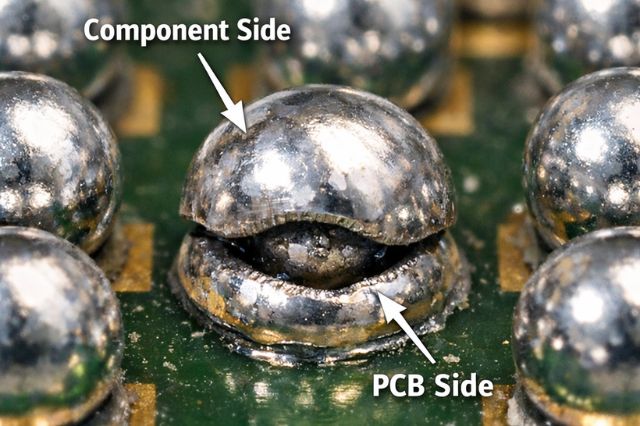
A head-in-pillow defect, often shortened to HiP, occurs during the reflow soldering process, typically in Ball Grid Array (BGA) components.
In simple terms, the solder ball (the “head”) and the solder paste (the “pillow”) fail to fully merge into a single, reliable joint. Although they may appear connected, they are not properly bonded at a metallurgical level.
This results in a weak or intermittent electrical connection that can fail under thermal or mechanical stress.
What makes this defect particularly challenging is that it often looks acceptable from the outside. The joint can appear normal, making it difficult to detect without advanced inspection methods.
Why Do Head-in-Pillow Defects Occur?
There isn’t usually just one cause. Head-in-pillow defects tend to be the result of a combination of process and material factors.
One of the most common causes is oxidation. If either the solder paste or the BGA solder balls become oxidised, it prevents proper wetting during reflow. This means the materials don’t fuse together as they should.
Another contributing factor is warpage. During the heating cycle, the PCB and the BGA component can warp slightly. If this movement causes the solder ball and paste to separate, even momentarily, they may not reconnect properly when the solder solidifies.
Reflow profile also plays a big role. If the temperatures or soak time aren’t optimised, the solder may not fully activate or bond correctly.
Other factors include:
- Poor solder paste quality or incorrect storage
- Contamination on pads or component leads
- Inconsistent placement accuracy
- Excessive vibration during reflow
It is usually a combination of these issues rather than a single root cause.
Why Head-in-Pillow Defects Are a Problem
At first glance, a head-in-pillow defect might not seem critical. Especially considering the joint can look fine and may even pass basic electrical testing.
The problem is how they affect overall reliability. These defects often lead to intermittent connections, which are far more difficult to diagnose than complete failures. A product might work perfectly during testing, only to fail in the field after exposure to temperature changes or mechanical stress.
This can result in increased returns, reduced product lifespan, damage to brand reputation and time-consuming fault finding and rework.
For industries where reliability is critical, such as aerospace, automotive or medical electronics, this kind of defect is simply not acceptable.
How to Detect Head-in-Pillow Defects
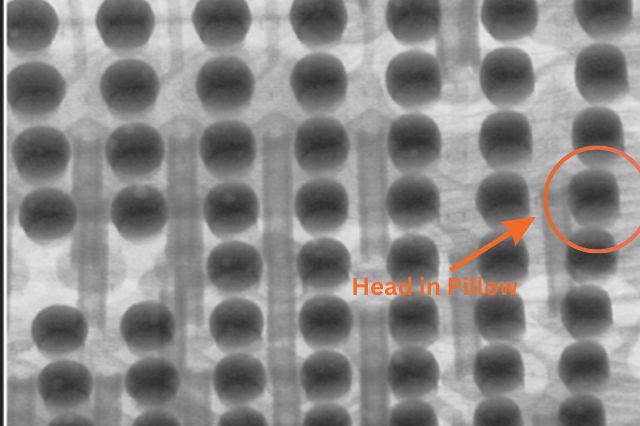
Because head-in-pillow defects are internal and not always visible, traditional visual inspection methods are often not enough.
This is where X-ray inspection becomes essential.
X-ray allows you to see inside the solder joint and identify whether the solder ball and paste have properly fused. A Head-in-pillow defect typically shows as a separation or incomplete bonding between the two.
At The Electronics Group, our X-ray inspection services are designed to identify exactly these kinds of hidden defects. If you suspect issues with your products or simply wish to have peace of mind and ensure top quality, send your items to us and we will inspect them for you to IPC standards.
How to Prevent Head-in-Pillow Defects
One of the most effective ways to reduce the risk of head-in-pillow defects is by optimising your soldering process. Making sure the temperature increases at the right rate and that the solder stays molten for long enough helps it flow and bond properly.
Material handling is just as important. Solder paste should be stored and handled according to manufacturer guidelines and components should be protected from oxidation and contamination.
You’ll also want to make sure your placement of components is accurate, pads are kept clean and environmental conditions are optimised. This is where structured training can make a real difference.
Learn How to Avoid Defects with IPC Training
If you’re looking to improve your process and reduce defects like head-in-pillow, IPC training is a solid investment.
Courses such as IPC-A-610 (Acceptability of Electronic Assemblies) and IPC J-STD-001 (Requirements for Soldered Electrical and Electronic Assemblies) provide a clear understanding of what good solder joints should look like, as well as the conditions that lead to defects.
At The Electronics Group, our IPC training courses go beyond theory. They’re designed to give professionals in the industry the practical knowledge needed to identify, prevent and troubleshoot defects in real-world environments.
By building this level of understanding within your team, you’re far more likely to catch issues early and avoid costly failures later.
Work With The Electronics Group to Prevent Head-in-Pillow Defects
Head-in-pillow defects are subtle and potentially costly if left unchecked. They don’t always show up during initial inspection, but they can have serious consequences once a product is in use.
The good news is that with the right combination of process control, training and inspection, they can be effectively managed.
Investing in IPC training helps your team understand how and why these defects occur, as well as how to prevent them. While X-ray inspection ensures you can detect them if they do slip through.
If you’re dealing with suspected solder joint issues or simply want to strengthen your quality process, we’re here to help.
Get in touch with our team at The Electronics Group today to discuss your inspection requirements or to find the right IPC course for your team.